
Part A: Chapter 4, Questions 1-3 & 8.
Question 1: Find two to three research papers, and illustrate the setup of the study. Ask a lab mate or classmate to do the same with the same study. Do your images look similar? Why or why not? (If the setups used in the research studies are clearly spelled out, your images will likely be similar to each other’s.)
Paper 1 Image:

I asked my classmate to read this study as well. Due to her busy time constraints, I allowed for her to just describe her interpretation of the set-up of the study, and then showed her my illustration. She described it very similarly to my interpretation, however, we had different understandings of the questions asked as there needed to be clarification of definitions to all of the participants involved in the study. For the most part, we had the same image of the set up for this study. Our difference in understanding the information provided to the participants could have been due to unclear methods sections or even complicated wording.
Paper 2 Title:Classrooms With Nature Views: Evidence of Differing Student Perceptions and Behaviors
Paper 2 Image:
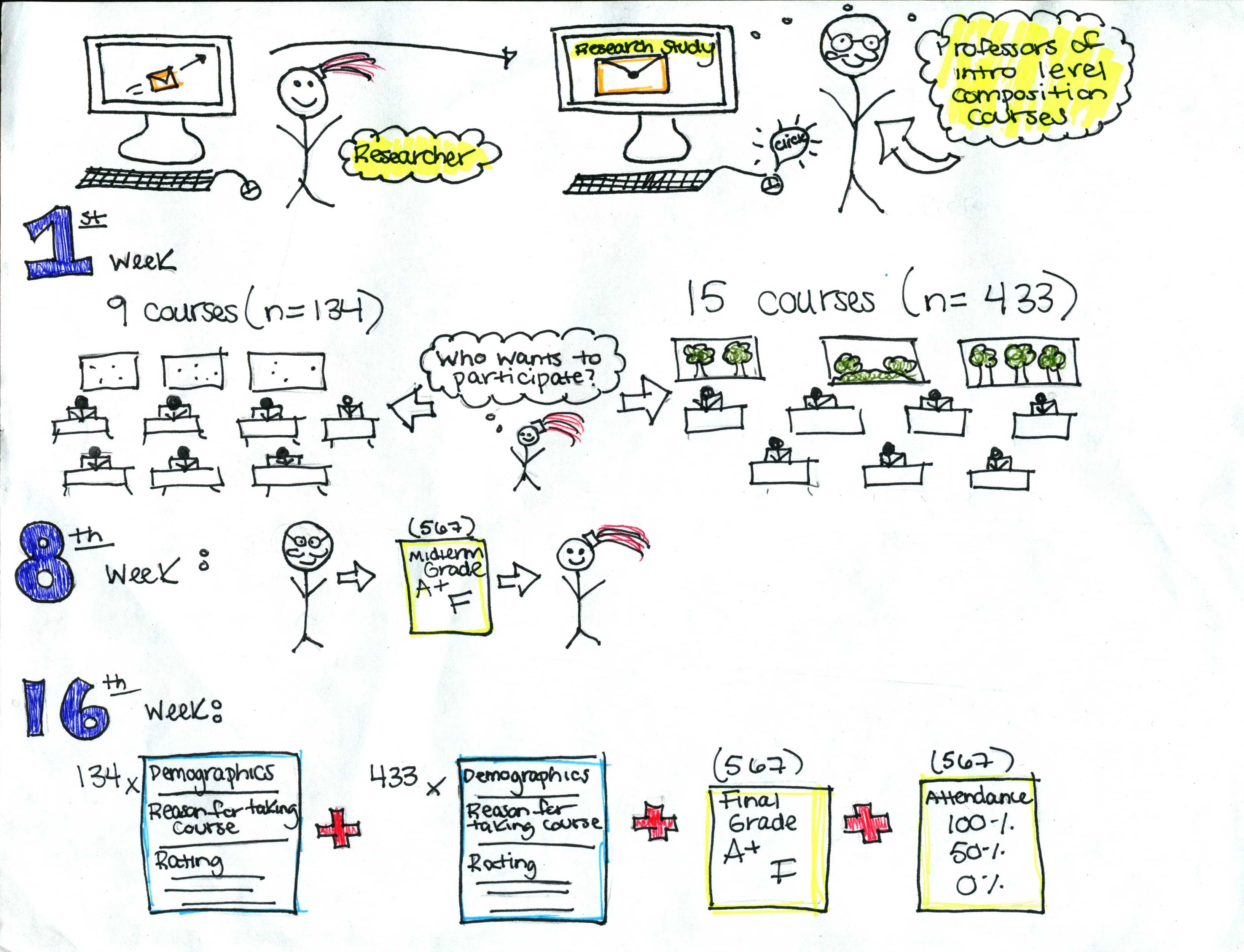
This study was interesting for me and my classmate. I asked her to read the study, describe the set-up, and then viewed my illustration, just as I did with the first paper. We had vivid matches and similar descriptions of what this study would look like. We both understood that the settings of the classrooms would vary by the outside view, that this was a 16 week long study, and even understood the questionnaire provided to the participants at week 16. This was a beautifully written paper in that it clearly described every action the researchers took with ample explanation as to why they did what they did. The clearness of the writing could have contributed to our similar interpretations, as well as that we both found the concept behind this study to be interesting, therefore getting more of our attention compared to the other one. This study was very engaged with the participants and had significant results in the end which made the reader eager to put themselves in the shoes of the researcher.
Question 2: The Internet (through such websites as YouTube, Pinterest, etc.) provides you the opportunity to get a “feel” for research. Many journals and laboratories also have videos available online. Here’s a link from one of my classes:http://pinterest.com/triciastriano/professor-tricia-striano Watching videos from other laboratories is one way to become familiar with various research paradigms and techniques. You may also get ideas about everything from how to position or hold a baby during a study to what sorts of stimuli other labs use in research studies. Find 10 videos. List the sources here. Share your observations with the class or laboratory, or perhaps even add them to your own social media site. Did watching these videos inspire any research questions? What are they?
https://www.youtube.com/watch?v=b6ZJRFwdF3c&feature=share&list=PLpAHd-5e7iIPIXBK5BFvseZzCrElSu18-
This video discusses having dialogue with a child when telling/ watching a story with them. Asking them these questions help them learn vocabulary and recall story-telling better. In this video, researchers show videos of kids watching a cartoon story with their parents. They use acronyms to help parents remember what and how they should ask questions such as PEER and CROWD and then show examples of this.
https://www.youtube.com/watch?v=fJ3yZDoRwOs
This video discusses using infrared eye movement and EEG’s to see if babies recall sounds. The research is good because if their siblings had any language/auditory issues, this technique can help prevent those problems from happening to their next baby. They do this by demonstrating the study and showing the visuals that the babies are seeing. Then they spoke to parents to see their opinions on it.
https://www.youtube.com/watch/?v=t_Y6wNWbNuE
This video is a study that was done at Rutgers to learn about how and when babies start learning. They do this by watching tv and playing with toys that help aid in memory. There is an EEG hooked up to their heads while doing this. They observe the learning happening and it usually puts the babies ahead of the game compared to others. EEG seems to be a very useful tool in analyzing how babies learn and how effective this learning is.
This video discusses when babies see the link between themselves and the image in the mirror. They placed a red mark on their forehead and before 18 months they do not make the connection but at 18 months, they do. They showed videos of babies doing the experiment and examples of how they do and don’t recognize themselves.
https://www.youtube.com/watch/?v=QGC8N13S4jA
The bobo doll experiment discusses how children imitate adults when they are being aggressive with the “bobo doll.” It is a video of kids hitting the doll and the researcher commenting on their observations.
https://www.youtube.com/watch/?v=rVqJacvywAQ
This video was about babies failing the object permanence test. There is a video of a baby playing with a toy, and the mother hiding the toy under a blue cloth. The baby looks confused and does not know what happened with it.
https://www.youtube.com/watch/?v=kBkqDqVge_c
This video is talking about the motor skills of babies. In the video, a baby is shown trying to walk across a narrow table. When there is no hand rail, she does not move forward and returns to her mom. When a stable hand rail is there, she hits it to make sure its stable and then tries to walk across. When an unstable rail was placed she moved it and tasted it and moved away because she knew it was not stable.
https://www.youtube.com/watch/?v=Tl_PfbeJRro
In this video, a baby is looking at two images of scattered dots change very fast. Most turns, the dots are in the same positions for both photos. There are a few times that the dots look different. When the baby notices, his eyes grow wide and he looks shocked. His hands slap the table he is on to show that he recognized the change.
https://www.youtube.com/watch/?v=O4a2RAyx1B8
This video discusses if babies can understand and think about what people say. An MRI was put on a baby and sentences were played normally and backwards and babies can discern what is forwards and backwards talk. Knowing what normal development is can help learn what atypical development is. They show diagrams of the babies brain and light up the parts of the brain where it is being used.
https://www.youtube.com/watch/?v=tLiP4b-TPCA
The researcher in this video uses diagrams and videos of young children to show that stress levels can affect development of children. If a child has positive stressors and is socially competent, learning will be at peak level. However, if a child has toxic stressors and has anxiety, the brain will not develop properly which can affect them in learning and later on in life.
Question 3 Describe the scenes/setups shown in Figures 4.1 and 4.2. Copy your descriptions and give them to someone without showing him or her the images. Can he or she draw the setups based on your descriptions? This exercise will help you better describe the setups in your own research paper. Repeat this procedure with your own images.
Figure 4.1: There is a young child, around 4 or 5 years old. They have mid length hair and it is falling over one of the child’s eyes. They are wearing dark boots below the knee, bright, possibly white pants, a white ruffle shirt with polka dots, and a jean jacket. There are 3 small toys laid out evenly in front of them, and the image shows the child placing a cup on the middle toy. There is a window in the background, with an “X” detail over it, that is low to the ground.
Figure 4.2: This child is most likely 18 months- 2 years old. They have very short wispy hair, and have a pacifier in their mouth. This child is wearing a white buttoned top with dark buttons going down the center, and the sleeves are unbuttoned and pushed up a bit. The child’s pants are medium toned with light and dark triangles printed all over them in various slants. The child is positioned with one leg stretched towards the right side of the photo, and the other leg seems to be stretched to the left but it is cut out of the photo. The child is holding toys in both of its hands, and is looking at them. One of the toys looks like a doll’s baby bottle, and the other looks like a kitchen toy. The child’s nails are painted. There are also two small toys in front of the child. The child seems to be sitting on a couch with a pillow/ throw behind it. The photo is zoomed in to only show the child and barely any of the background.
Question 8: Make a list of relevant research-related talks and events in your community occurring this month. Do not forget to consider museums, theaters, clubs, and any other relevant venues.
The following research-related talks that I found for the month of March all reflect either topics of development that I am interested in (I/O, workplace development, organizational impacts), conferences that could help guide me towards success with my midterm/final project (improving child development in autisim populations through the environment), or even events that could assist me with writing excellent research papers.
This search for talks and conferences occurring in New York City for March showed me that these events can be expensive!! However, there are SO many opportunities that provide free or discounted tickets for college students. I am glad that I am aware of these events that are occurring around me and will definitely try to check out ones that I found to be interesting.
March 13- Everyone Reading Conference –Learn new strategies from noted experts in the field and experience the latest in teaching resources, technologies, schools and program
March 15 – Ethics by DESIGN– Through a mixture of keynote presentations, panels and research roundups, our participants will discuss individual behavior, group norms and legal/regulatory systems and how these relate to designing ethical systems in organizations.
March 15 – Building Organizational Skills and Executive Functions in Children with ADHD and Related Conditions – will help classroom teachers, psychologists, social workers and special education teachers gain strategies to help their students with organizational skills that will improve their school functioning as well as enhance their self-esteem and general well being
March 16 – Research Writing Process Workshop
March 16 – Business and Creative Conference – Gain a wealth of knowledge and practical principles that will help shift your business and vision into productivity and growth.
March 19 – Organizational Skills Training – Participants will encounter improved productivity, better management, and an overall increase in professional growth.
March 21 – Our Brain on A.I. – Learn about the human and social implications of artificial intelligence and machine learning through the concerns and questions
March 21 – Data Privacy and Big Data Ethics
March 27– Autism Science Foundation TED-Style Autism Science Conference
March 29 – MLconf is a single-day, single-track machine learning conference event designed to gather the community to discuss the recent research and application of Algorithms, Tools, and Platforms to solve the hard problems that exist within organizing and analyzing massive and noisy data sets
March 30 – Pratt Research Open House – Learn more about tools for archeological visualization, advanced methods for participatory community development and unique approaches to place-based storytelling.
Part B: Chapter 5, Questions 1, 3 & 4.
Question 1: Consider your research question. What’s the big question that you are addressing?
Our big question is how does the role of social media impact the self-image of teenage girls?
What’s the specific question that you are addressing?
Our specific question is in what ways does social media affect teenage girls self-image?
What literature did you read to inspire this question?
1. Cribb, & Haase. (2016). Girls feeling good at school: School gender environment, internalization and awareness of socio-cultural attitudes associations with self-esteem in adolescent girls. Journal of Adolescence,46, 107-114.
Summary: This article is about the way school can influence the self-esteem of adolescent girls. The experiment was conducted with two separate school environments to study the differences of appearances, attitudes, associations, and social influences with self-esteem. The two types of school environments were co-educational and single sex.
2. Theran, S. (2010). Authenticity with authority figures and peers: Girls’ friendships, self-esteem, and depressive symptomatology. Journal of Social and Personal Relationships, 27(4), 519-534.
Summary:This study focused on how relationships and mental prosperity can ethnically influence 14-year-old young ladies’ self-esteem and depressive symptomatology. They analyze how the approval, support, and emotional social support from family members direct the connection between authenticity involved with power figures and depressive symptomatology.
3. Barker, E., & Bornstein, M. (2010). Global Self-Esteem, Appearance Satisfaction, and Self-Reported Dieting in Early Adolescence. Journal Of Early Adolescence, 30(2), 205-224.
Summary:This article examines global self-esteem, appearance satisfaction, and self-reported dieting and how they are interrelated. They experiment across early adolescents from age 10 to 14. They were European American adolescents and 40% of them were girls. Adolescents seem to be less satisfied with their appearance at age 10. Girls with high body mass index at age 10 were less satisfied with their appearance at age 14.
4. Dorak, F. (2011). SELF-ESTEEM AND BODY IMAGE OF TURKISH ADOLESCENT GIRLS. Social Behavior and Personality, 39(4), 553-561.
Summary:This study examined the relationship between self-esteem and body image in female adolescents who were athletes or nonathletes. These adolescent girls between the ages of 12-14 were Turkish. There seems to be a strong significant relationship between self-esteem and body image in the athletic girls compared to the nonathletic girls.
5. Romo, L., Mireles-Rios, R., & Hurtado, A. (2016). Cultural, Media, and Peer Influences on Body Beauty Perceptions of Mexican American Adolescent Girls. Journal of Adolescent Research, 31(4), 474-501.
Summary:This article examines how social and cultural values influence the types of bodies that adolescent girls consider beautiful and desirable. This experiment used 27 Latina mid-adolescent girls between the ages 14 to 16 to share what body shapes and sizes are valuable in Latino and European American culture. They were also asked whether boys consider large body sizes acceptable. Influences like friends’ opinions, perceptions of boys’ dating preferences, norms in their communities, and body shapes of female celebrities in Latino media play a role in adolescents’ thoughts of beauty and desirability.
6. Dohnt, H., Tiggemann, M., & García Coll, Cynthia. (2006). The Contribution of Peer and Media Influences to the Development of Body Satisfaction and Self-Esteem in Young Girls: A Prospective Study. Developmental Psychology, 42(5), 929-936.
Summary:This study examined the role of peer and media influences in the development of body satisfaction in young girls as well as their relationship between body satisfaction and self-esteem. They used television programs that focused on appearance to find the young girls appearance satisfaction and their desire for thinness. They found that girls’ desire for thinness was found to temporally pursue low self-esteem. Girls appear to already have the thin ideal to follow which negatively influences the development of body image and self-esteem.
7. Mcvey, Tweed, & Blackmore. (2007). Healthy Schools-Healthy Kids: A controlled evaluation of a comprehensive universal eating disorder prevention program. Body Image, 4(2), 115-136.
Summary:This experiment focused on a school-based universal program involving male and female students, parents, teachers, school administrators, and local public health professionals. They completed self-report surveys measuring body satisfaction, internalization of media ideals, size acceptance, disordered eating, weight-based teasing, weight loss and muscle-gaining behaviors, and perceptions of school climate.
8. Alm, S., & Låftman, S. (2018). The Gendered Mirror on the Wall: Satisfaction with Physical Appearance and Its Relationship to Global Self-esteem and Psychosomatic Complaints Among Adolescent Boys and Girls. Young,26(5), 525-541.
Summary:This study investigated gender differences in satisfaction with physical appearance as a domain-specific aspect of self-esteem. Participants were ninth grade students from age 15 to 16. Girls resulted in having lower satisfaction with their appearance than boys. Satisfaction with appearance was strongly associated with global self-esteem among girls. This means that girls cared about their appearance much more than boys which affected their self-esteem.
9. Kutob, R., Sent, J., Crago, M., & Shisslak, C. (2010). Concurrent and Longitudinal Predictors of Self-Esteem in Elementary and Middle School Girls. The Journal of School Health, 80(5), 240.
Summary: This study investigates the effects of factors related to self-esteem among 2 cohorts of girls over a period of 4 years from elementary through middle school. Their study included 103 questions that had to do with self-esteem, appearance appraisal, effect of body changes, depressed mood, teasing, school performance, and other factors. They also weighted participants heights and weights. They found that the most important predictor of self-esteem in each grade was appearance appraisal. They also found that weight-related teasing was a predictor of boys and girls’ self-esteem. Self-esteem was lower in girls who were teased about their weight than boys.
10. Rg Phillips, & Aj Hill. (1998). Fat, plain, but not friendless: Self-esteem and peer acceptance of obese pre-adolescent girls. International Journal of Obesity, 22(4), 287-293.
Summary:This study focuses on how body weight influences pre-adolescent girls self-esteem and peer acceptance. They experimented with girls in four weight measurement groups. Their assessments consisted of body weight and height, body shape preference, self-esteem, and peer nominations of popularity and attractiveness. Their results were that obese and overweight girls had significantly lower physical appearance and athletic competence self-esteem than their normal weight peers. Overweight girls were less likely to be nominated as pretty by their peers.
Question 3: Find six research journals. What is the scope of each journal (as defined in its website and the journal’s pages)?
1.Journal of Health Psychology
Scope: Journal of Health Psychology is an international peer-reviewed journal that aims to support and help shape research in health psychology from around the world. It provides a platform for traditional empirical analyses as well as more qualitative and/or critically oriented approaches. It also addresses the social contexts in which psychological and health processes are embedded.
Studies published in this journal are required to obtain ethical approval from an Institutional Review Board. Such approval must include informed, signed consent by all research participants. Any manuscript not containing an explicit statement concerning ethical approval and informed consent will not be considered.
2.Journal of Pediatric Psychology
Scope: The Journalof Pediatric Psychology (ISSN 0146-8693) is published ten times a year by Oxford University Press for the Society of Pediatric Psychology, PO Box 170231, Atlanta, GA 30317. The journal is the scientific publication of the Society of Pediatric Psychology (SPP), Division 54 of the American Psychological Association, whose mission is to promote the health and psychological well-being of children, youth and their families through science and an evidence-based approach to practice, education, training, advocacy, and consultation. As such, the journal publishes articles related to theory, research, and professional practice in pediatric psychology.
Pediatric psychology is an interdisciplinary field addressing physical, cognitive, social, and emotional functioning and development as they relate to health and illness issues in children, adolescents, and families. The journal publishes papers on a wide variety of topics exploring the interrelationship between psychological and physical well-being of children, adolescents, and families including: psychosocial and developmental factors contributing to the etiology, course, treatment, and outcome of pediatric conditions; assessment and treatment of behavioral and emotional concomitants of disease, illness, and developmental disorders; the role of psychology in healthcare settings; behavioral aspects of pediatric medicine; the promotions of health and health-related behaviors; the prevention of illness and injury among children and youth; and issues related to the training of pediatric psychologists.
3. Journal of Adolescent Research
Scope: The aim of the Journal of Adolescent Research is to publish informative and dynamic articles from a variety of disciplines that focus on development during adolescence (ages 10 to 18) and early emerging adulthood (18-22). We are particularly interested in papers that use mixed-methods, systematically combining qualitative and quantitative data and analyses. We also seek rigorous qualitative research using a variety of strategies including ethnography, in-depth interviews, case studies, photo elicitation, and the like. We focus on work that takes a strengths-, or assets-, based approach to adolescent development. Our goal is to expand upon the understanding of a diverse range of experiences of adolescents and emerging adults across a variety of contexts.
4. Journal of Adolescence
Scope: The Journal of Adolescence is an international, broad based, cross-disciplinary journal that addresses issues of professional and academic importance concerning development between puberty and the attainment of adult status within society. Our focus is specifically on adolescentdevelopment: change over time or negotiating age specific issues and life transitions. The aim of the journal is to encourage research and foster good practice through publishing empirical studies, integrative reviews and theoretical and methodological advances. The Journal of Adolescence is essential reading for adolescent researchers, social workers, psychiatrists, psychologists, and youth workers in practice, and for university and college faculty in the fields of psychology, sociology, education, criminal justice, and social work.
5. The Journal of Social and Personal Relationships
Scope: The Journal of Social and Personal Relationships (JSPR) is an international and interdisciplinary peer-reviewed journal that publishes the highest quality original research on social and personal relationships. JSPR is the leading journal in the field, publishing empirical and theoretical papers on social and personal relationships. It is multidisciplinary in scope, drawing material from the fields of social psychology, clinical psychology, communication, developmental psychology, and sociology.
6. Journal of School Health
Scope: Journal of School Health is published 12 times a year on behalf of the American School Health Association. It addresses practice, theory, and research related to the health and well-being of school-aged youth. The journal is a top-tiered resource for professionals who work toward providing students with the programs, services, and environment they need for good health and academic success
List links to journals here.
Journal of Health Psychology: https://journals.sagepub.com/loi/hpq
Journal of Pediatric Psychology: https://academic.oup.com/jpepsy/pages/About
Journal of Adolescent Research: https://us.sagepub.com/en-us/nam/journal/journal-adolescent-research#description
Journal of Adolescence: https://www.sciencedirect.com/journal/journal-of-adolescence/about/aims-and-scope
Journal of Social and Personal Relationships: https://us.sagepub.com/en-us/nam/journal/journal-social-and-personal-relationships#description
Journal of School Health: https://onlinelibrary.wiley.com/page/journal/17461561/homepage/productinformation.html
Copy one journal’s statement of its “scope” here.
Journal of Adolescent Research
The aim of the Journal of Adolescent Research is to publish informative and dynamic articles from a variety of disciplines that focus on development during adolescence (ages 10 to 18) and early emerging adulthood (18-22). We are particularly interested in papers that use mixed-methods, systematically combining qualitative and quantitative data and analyses. We also seek rigorous qualitative research using a variety of strategies including ethnography, in-depth interviews, case studies, photo elicitation, and the like. We focus on work that takes a strengths-, or assets-, based approach to adolescent development. Our goal is to expand upon the understanding of a diverse range of experiences of adolescents and emerging adults across a variety of contexts.
Imagine that you are submitting a research paper to the journal. What is the title of your paper as a function of each journal’s scope, as defined above? Provide six titles for the same research paper. Do these titles reflect the question? Why is the question important, and what is new in your study?
The title of my paper would be Emerging Adolescence: Puberty Factors that Contribute to Adolescent Behaviors. Six other titles for this same research paper will be: Change in Behavior within Adolescents, What Factors Influence Adolescent Development?, How do hormones affect adolescent behavior?, Pubertal Development and Behavior in Adolescents, How does early vs late puberty change adolescent behavior?, What mental, social, and physical change do adolescents go through when going through puberty? All these titles reflect the question. The question is important because it researches the different factors that can affect an adolescent’s behavior through puberty. Perspectives of mental, social, and physical change is new in my study. Also, biological influences such as hormones is also new in my study.
Question 4: Read the submission guidelines of three journals. Which journal(s) would you select for your paper?
1. Association for Psychological Science
2. Sage Journal of Health Psychology
3. University of Illinois Press
Write an abstract for a possible research study. How does the abstract change as a function of each journal’s scope and submission guidelines?
Sample abstract: Social media has evolved in drastic ways over the past ten years, which affects adolescents in many ways in terms of how they see themselves and others. It has allowed for girls to constantly compare themselves to unrealistic images they see online, which are often marketing ploys or put online deliberately to catch peoples attention. This research study looked at girls of ages 12-21 to see how they believe social media affects them.
Different journals have different requirements. Some journals require completely original ideas and studies, so anything done previously wouldn’t be allowed. One of the journalsI chose requires a psychological idea to be linked to emerging/ established areas of research. Some psychological journals require connection only to mind, brain, and behavior. Also, different journals have different word and citation minimum/ maximums which affect the abstract.
Part C: Chapter 6, Questions 1 & 6
Question 1: You have just started your own laboratory that studies cognitive development among 3- to 7-year-olds. Design your logo here.

You have just started your own laboratory that studies stress among college-age students taking research methods classes. Design your logo here.

Show your logo to five people. What are their comments?
Person 1: “ I like your second logo with college students stress, but I think since the first one is for children, maybe add more color and pictures in it”
Person 2: “Haha, the second one is the story of my life. I think it is perfect. I like the first one as well, but I feel like it is a bit plain.”
Person 3: “Hmmm… I liked that you included the definition of stress in the second one and I like how it’s very colorful and detailed. I also like the first one, but I would suggest maybe adding more things to do with cognitive than just a puzzle in the brain”
Person 4: “ Nice. I like them both”
Person 5: “Wow the second one is me during midterms and finals week, that logo speaks to me. I like the first one too.”
Can you improve your logo based on their comments? Why or why not? If so, design another one or two on the next page.
Based on their comments, I believe that they are right about my first logo being too plain. For a change, I will add more color to it and make it look more appealing for children ages 3- to 7-year-olds. As for the second one, everyone that I had shown liked it and did not suggest any changes to be made to it, and therefore, I will keep it as it.
New cognitive development among 3- to 7-year-olds Logo

Question 6: Find three ads for research studies on the web. List the links here. What are the pros and cons of each? Would you participate in the studies? Why or why not?
Pros: Memory screening is free
Cons: Not much information on this
I would not participate in this because I would not fit the age range (60-85). It also does not list much information on the topic.
Pros: Explains the study well and lists the rules for the study; travel can be compensated
Cons: Very specific people can do this; not something anyone can do
I would participate in this study if I did drink. This is because all the rules are laid out clearly and it would be interesting to see how recreational alcohol can affect people long term.
Pros: Stipend up to $4,800
Cons: Must be available for inpatient for 3 days; an implant would be placed on you
I would not do this since it is slightly time consuming. They would have an implant on me, which I am wary of since I am not sure how that would affect my body.

 Research Methods in Developmental Psychology